

Medical dictation: no longer a luxury

By Daryl Green, Account Director and Employee Director, Voice Technologies


Posted on November 10, 2025
Until fairly recently, speech recognition software wasn’t much more than a novelty. Even once it started to break into the workplace, it was still largely deemed as a luxury, and not something professionals would actually rely on to help them through their work day. Now, speech recognition is a necessity for many professionals - and that’s largely down to the emergence of medical dictation.
In today’s blog, we’ll look at why healthcare professionals prefer speech recognition software that’s specifically designed for their sector - and why this tech is no longer a luxury.
Do healthcare professionals use medical dictation?
Yes. More and more healthcare teams, particularly in the NHS, are relying on speech recognition software. These platforms boast numerous features, but the main reason for their increased adoption is their ability to trim down the admin in any given work day.
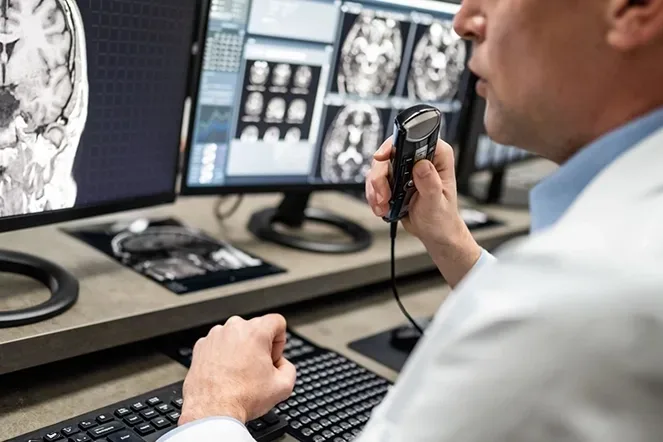
For those in fully administrative roles, speech recognition software allows them to automatically transcribe their words rather than type everything out, which can dramatically speed up document creation. Clinicians can reap all the same benefits, but they can also automatically transcribe entire consultations with patients. This means they don’t have to concentrate on manually writing notes, and can instead fully focus on what the patient is saying. It also means nothing from the consultation will be missed.
Regardless of your role in the healthcare sector, speech recognition software cuts down on repetitive admin, freeing up that time for more focused patient care.
Why medical dictation is more effective than dictation tools for general use
Most dictation tools built for general use are fast, and highly accurate. But medical dictation refers to platforms that were built specifically for the healthcare sector, and therefore feature built-in medical vocab. That means that even if you’re using complex jargon that’s specific to your sector, the platform will most likely be able to transcribe that jargon accurately. If you used a tool for general purpose, there’s more chance that certain medical terms wouldn’t be included in the built-in vocab, which would lead to mistakes in your transcriptions.
Even a single transcription error can cause real problems in the healthcare sector, so medical dictation is highly recommended over general purpose platforms (although, even when you’re using platforms with medical vocab, you should always be proofreading anyway; no speech recognition software is 100% accurate).
Why speech recognition is no longer a luxury in the healthcare sector
There’s several reasons why speech recognition is becoming increasingly necessary in this sector:
Admin burnout
The NHS has been struggling for many years, and one of the biggest contributing factors to this is administrative burnout. Clinicians regularly report that a significant portion of their average work day is spent on admin, and that’s all time that they’re unable to spend on patient care. On top of that, piles of endless admin can have a detrimental effect on job satisfaction, and lead to a great deal of unnecessary stress. Speech recognition software designed for the healthcare sector can greatly reduce this burden, by speeding up the entire documentation process.
The demands of compliance in the healthcare sector
Naturally, healthcare is a sector that’s heavily regulated, so accurate and timely documentation is essential. Delayed, incomplete, or inaccurate documents can have repercussions for both the healthcare provider, and the patient. Speech recognition for healthcare means that documents can be produced faster, and not at the expense of accuracy.
Conclusion (medical dictation: no longer a luxury)
Speech recognition is no longer a novelty, and that’s especially true in healthcare. Administrative burnout is one of the biggest problems facing the sector, and specialised dictation tools are the first step towards solving it.